Back to Blog
Geospatial AI

FOTBCD: A Geographically Diverse Dataset for Building Change Detection from High-Resolution Aerial Imagery

We announce FOTBCD, a national-scale building change detection dataset derived from authoritative French orthophotos and topographic data, designed for robust geographic generalization and commercial use.

RA
Retgen AI Labs
January 29, 2026
6 min read
Building Change DetectionRemote SensingGeospatial AIDataset Release
FOTBCD: A Geographically Diverse Dataset for Building Change Detection from High-Resolution Aerial Imagery

FOTBCD: A Geographically Diverse Dataset for Building Change Detection from High-Resolution Aerial Imagery

Building change detection is a foundational problem in geospatial intelligence, with applications ranging from urban planning and cadastral maintenance to infrastructure monitoring and risk assessment. Despite significant progress in deep learning, many existing benchmarks remain limited by narrow geographic scope, small scale, or restrictive imagery licenses that prevent real-world deployment.

FOTBCD was created to address these limitations.


What is FOTBCD?

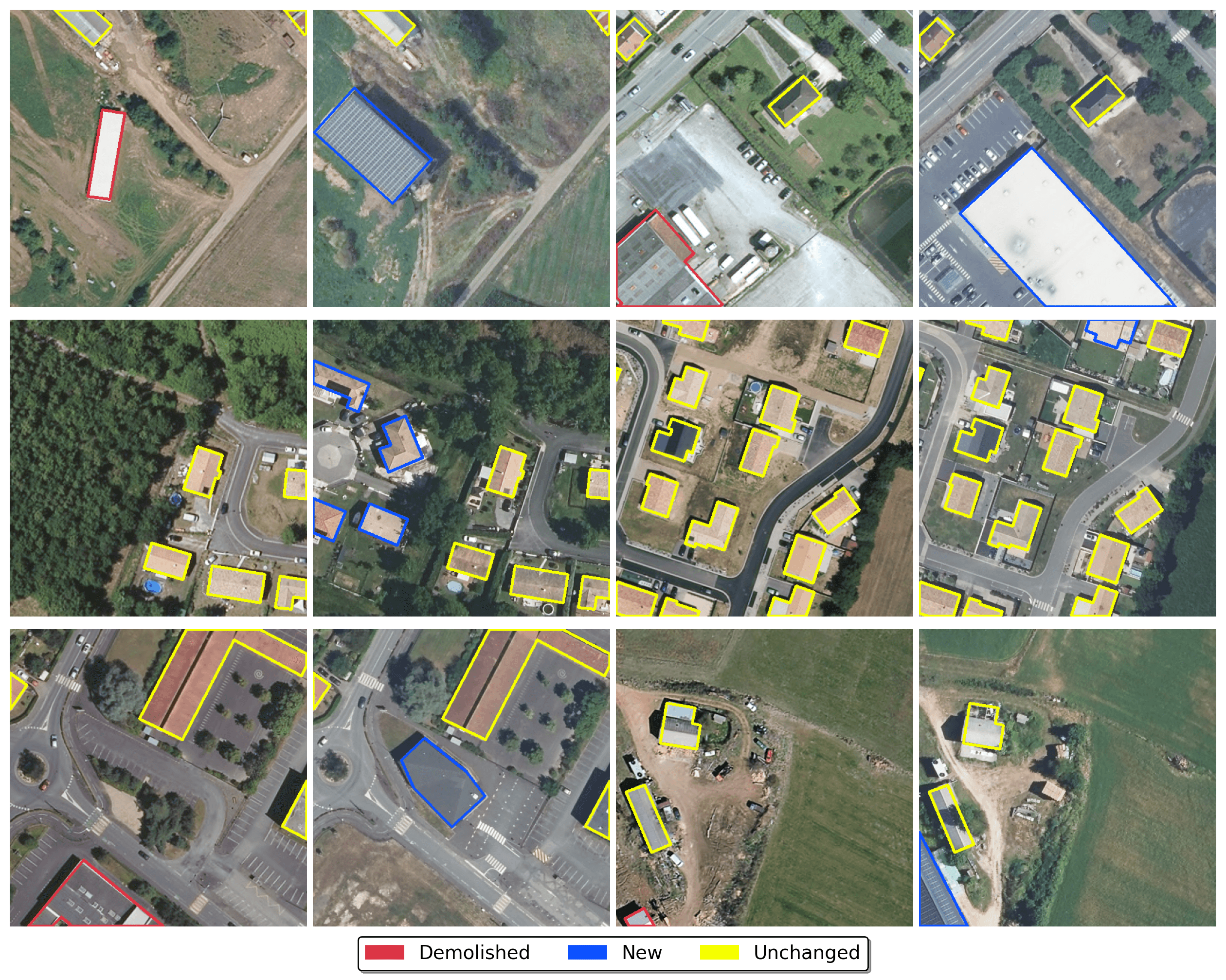
FOTBCD is a large-scale building change detection dataset derived from authoritative geographic data released by IGN France. It combines very-high-resolution aerial orthophotos with official topographic building footprints to provide reliable, reproducible ground truth for building change detection.

The dataset spans 28 departments across mainland France, with 25 departments used for training and 3 geographically disjoint departments held out for validation and testing. This strict geographic split ensures that models are evaluated under genuine spatial domain shift rather than benefiting from regional overlap or dataset leakage.

All imagery is provided at 0.2 m spatial resolution, capturing fine-grained building geometry across dense urban centers, suburban areas, rural regions, coastal zones, and mountainous terrain.

Beyond binary change detection

Most existing benchmarks treat building change detection as a binary segmentation task: change versus no change. While useful, this formulation hides important semantic distinctions.

FOTBCD supports directional building change understanding. Buildings are labeled according to whether they newly built, demolished, or remained unchanged between acquisition dates. This enables models to distinguish construction from demolition, which is essential for many real-world applications.

To support different use cases, FOTBCD is released in two complementary research datasets:

  • FOTBCD-Binary, the primary dataset used in our experiments, provides binary building change masks optimized for large-scale training and benchmarking.
  • FOTBCD-Instances, a smaller research subset that preserves the original instance-level polygon annotations, intended for instance-level evaluation and analysis rather than large-scale training.

Both datasets are derived from the same underlying data.

Designed for generalization

A central goal of FOTBCD is to encourage models that generalize across geography rather than overfitting to local appearance patterns. By spanning diverse architectural styles, climates, and landscapes within a single national dataset, FOTBCD forces models to learn change-related cues that transfer beyond a single city or region.

In cross-dataset experiments, models trained on FOTBCD demonstrate substantially better transfer behavior when evaluated on other benchmarks, while models trained on geographically constrained datasets show sharp performance degradation when evaluated on FOTBCD. These results highlight the importance of geographic diversity as a first-order factor in building change detection.


Built for real-world deployment

Many widely used building change detection datasets rely on Google Earth imagery, which restricts commercial use under Google’s Terms of Service. This creates a gap between academic research and deployable systems.

FOTBCD is derived entirely from IGN France’s open data program, providing a legally clear foundation for both research and commercial applications. In addition to the research releases, we offer FOTBCD-220k, a large-scale commercial dataset containing over 220,000 image pairs under a dedicated license.


Data and code

All research datasets, training scripts, configuration files, and pretrained model checkpoints are distributed through the same repository.

Acknowledgments

FOTBCD is derived from BD ORTHO and BD TOPO databases made freely available by the Institut National de l’Information Géographique et Forestière (IGN) under the Licence Ouverte / Open Licence v2.0.